


INCORPOREUS VOL.1
Jane Bustin
Tomo Campbell
Joseph Kosuth
Steve McQueen
Rebeca Romero
Erik Swars
Danh Vo
Hosting Pareidolia Foundation
16/05 - 14/07/2026

Notes on Presence Without Object
There is a moment, in 1957 at the Sorbonne, when Yves Klein speaks about the possibility of an art that might one day abandon the object altogether. Not an art of representation, nor even abstraction in the traditional sense, but an art liberated from the burden of material permanence. An art existing as sensibility, as atmosphere, as condition.
Nearly seventy years later, that proposition no longer appears visionary. It appears inevitable, and yet inevitability should always make us suspicious.
The history of modernity is filled with ideas that promised liberation while quietly producing new forms of absence. Every technological extension enlarges us while simultaneously distancing us from something else. Marshall McLuhan understood this with unusual clarity: media do not merely communicate experience; they reorganize perception itself. They extend the nervous system outward, until eventually the distinction between the human being and his extensions becomes unstable.
This instability may be the true territory of the immaterial.
Not the disappearance of matter, but the gradual displacement of presence.
The works gathered in Incorporeus Vol. I do not attempt to illustrate a theory. They inhabit a condition. Each work approaches, from a different angle, the possibility that the artwork is no longer entirely located within itself. Meaning drifts. Form loosens. Presence becomes uncertain.
Tomo Campbell’s painting begins with the historical figure of Napoleon, but history here no longer functions as narrative. The image seems to dissolve while remaining stubbornly visible, as though memory itself had become atmospheric. The figure survives only as vibration, as residue, as unstable rhythm. One has the sensation that history is no longer being represented, but evaporating in front of us.
In Erik Swars’ moving image work, disappearance becomes even more radical. Colours recede. Edges lose definition. Bodies refuse permanence. Movement can barely be retained by the eye before it slips away again. Yet this is not cold formalism. There is, paradoxically, an extraordinary intimacy in Swars’ commitment to reduction. His minimalism does not impoverish perception; it purifies it. The image no longer dominates the viewer. It trembles at the threshold of visibility, forcing us to participate in its completion.
Steve McQueen’s Bounty 47 offers another kind of resistance. A fragile yellow flower persists against the immense historical shadow of colonial violence. Here fragility itself acquires political force. The work does not monumentalize suffering. It refuses monumentality altogether. Instead, it proposes endurance as a quieter and perhaps more radical form of survival.
Jane Bustin’s terracotta bowl returns us to the elemental. Earth shaped by hand. A vessel reduced to its most irreducible condition. In an age increasingly governed by simulation and abstraction, the bowl appears almost unreasonable in its simplicity. And yet its silence carries an unusual density. It reminds us that before systems, before networks, before images, there was touch.
Rebeca Romero’s metal plate, generated through artificial intelligence, moves in the opposite direction entirely. Here the known universe is translated into computational mapping, transformed into surface through processes increasingly detached from direct human gesture. The work is both seductive and unsettling. It asks whether knowledge, once fully externalized into systems, can still remain human knowledge at all.
Joseph Kosuth work included within our Incorporeus Vol. I exhibition perhaps brings Klein’s intuition to its clearest contemporary articulation, in our interpretation. “Any glass of 5 ½ foot square sheet of glass to lean against any wall.” The artwork ceases to exist as an object and survives instead as a proposition. The material form becomes secondary to the conceptual condition that generates it. The work exists everywhere and nowhere simultaneously. It is infinitely repeatable, yet strangely elusive.
What emerges across these works is not a celebration of dematerialization.
On the contrary, one begins to sense a growing tension between disappearance and recovery. Between extension and loss. Between the future and the human need for orientation.
Pareidolia Foundation was created precisely within this tension.
Its purpose is not merely exhibition-making, but research: the exploration of how aesthetic experience continues to transform under contemporary conditions. Discovery remains central to this process, but discovery alone is insufficient without wonder. Wonder is not decorative. It is methodological. It is the condition that allows perception to remain open before reality hardens into certainty.
Perhaps this is why the exhibition does not point comfortably toward the future.
Perhaps it points against certain futures.
Against the illusion that acceleration necessarily produces understanding. Against the belief that technological sophistication alone can sustain human depth. Against the increasingly passive acceptance of systems that replace experience with simulation.
But resistance alone is also insufficient.
What is needed instead may be a form of scaffolding — a bridge structure between tradition and whatever comes next. Not nostalgia for the past, nor blind faith in innovation, but an attempt to preserve continuity while entering unknown territory.
This may ultimately be the deeper question Klein leaves behind. Not whether art can become immaterial, but whether humanity can remain present within the immaterial world it is constructing around itself.
The works assembled here do not resolve that question.
They simply refuse to close it.


Joseph Kosuth, A Leaning Glass - Five and Half Foot, Five and half foot sheet of glass and metal plaque, 167.64 x 167.64 cm / 66 x 66 in, 1965


Tomo Campbell, Untitled, Oil on canvas, 100.7 x 90.3 cm / 39 5/8 x 35 1/2 in, 2015


Danh Vo, 2.2.1861, Ink on paper, writing by Phung Vo, 29.6 x 21 cm / 11 5/8 x 8 1/4 in, 2009


Jane Bustin, Yellow blush, Red clay, slip, glaze, stain, rake fired, Marcel Proust The Captive 1974 edition, Dimension variable, 2021


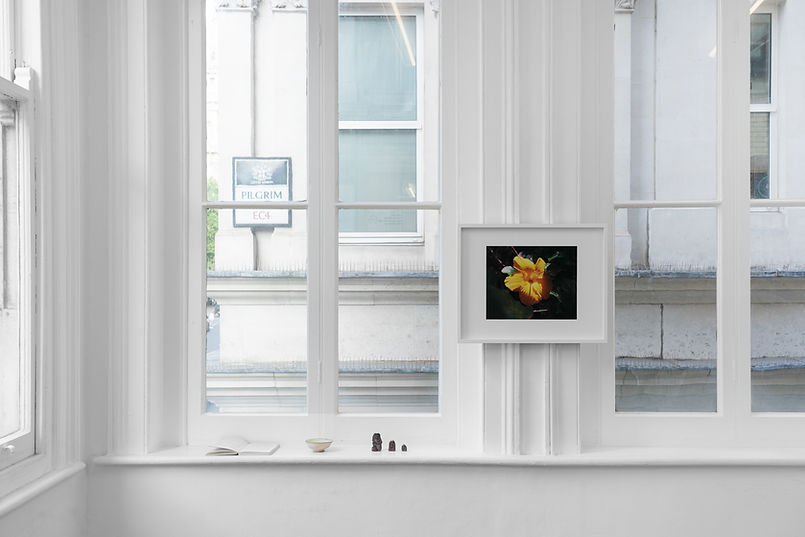

Steve McQueen, Bounty 47, Archival inkjet print; Dibond mounted, 41.9 x 53.5 cm / 16 1/2 x 21 in, edition 2 of 4 + 2 AP, 2024


Rebeca Romero, Early Horizon, Fiber laser engraved plaque, brass cylinders,32 x 32 x 2.5 cm / 12.6 x 12.6 x 0.98 in, 2022


Erik Swars, NTY (Crying wolf), 4 minutes 46 seconds, Single channel video, edition 1 + 1 AP, 2025
